


Geography and population
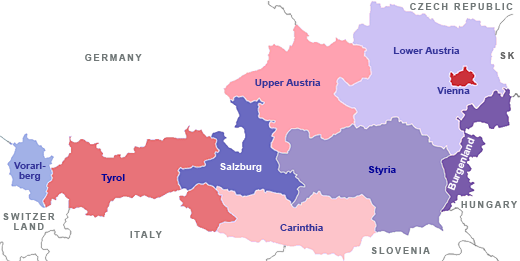
Austria covers an area of 83,878 square kilometres with a population of 8,822,267 residents (as of 1 January 2018), including 1,395,880 foreign citizens (15.8% of total population). In 2017, an average of 1,970 million people with migration background lived in Austria, that is 22.8% of the entire population.
Vienna is Austria’s most densely populated province with 4,500 residents per square kilometre; Tyrol and Carinthia are the least densely populated provinces with 59 inhabitants per square kilometre. The average life expectancy is for woman 83.9 years and for man 79.3 years.
Austria is bordered by Switzerland, Liechtenstein, Germany, the Czech Republic, Slovakia, Hungary, Slovenia and Italy.
Austria is a federal state comprised of nine provinces; each province has its own capital:
Province | Population | Provincial Capital | Population |
Burgenland | 292,675 | Eisenstadt | 14,476 |
Carinthia | 560,898 | Klagenfurt | 100,369 |
Lower Austria | 1,670,668 | St. Pölten | 54,649 |
Upper Austria | 1,473,576 | Linz | 204,846 |
Salzburg | 552,579 | Salzburg | 153,377 |
Styria | 1,240,214 | Graz | 286,292 |
Tyrol | 751,140 | Innsbruck | 132,493 |
Vorarlberg | 391,741 | Bregenz | 29,806 |
Vienna | 1,888,776 | - | - |
(S: Statistik Austria, 1.1.2018)
Economy
The Austrian economy grew by 3.0% in 2017. GDP at current prices amounted to approximately € 369,69 bn (+4.6% in real terms) in 2017 and GDP per inhabitant equalled € 42,020. Austria is in the upper sector not only within the EU but world-wide (source: Statistik Austria).
The Austrian economic structure is mainly dominated by small and medium enterprises. The most important industrial branches are:
- Food industries
- Machine and steel industry
- Chemical and vehicle industry
- Electric and electronic industry
- Wood and paper industry
Climate
Austria has a typical central European transitional climate, i.e. warm summers, cold winters and adequate precipitation.
Additionally, there are two distinct climatic regions in Austria:
- The east shows a Pannonian climate (warm to hot summers, relatively low precipitation and cold winters).
- The central Alpine region has the characteristic features of the Alpine climate (more precipitation in summer compared to the east and long winters with heavy snowfall).
» mehr lesen
 Top
Top

